
Basant Festival in Pakistan 2026 Lahore 🪁(6th–8th February)
The official dates, rules, safety zones, registration details, and government plan for the festival are as follows:
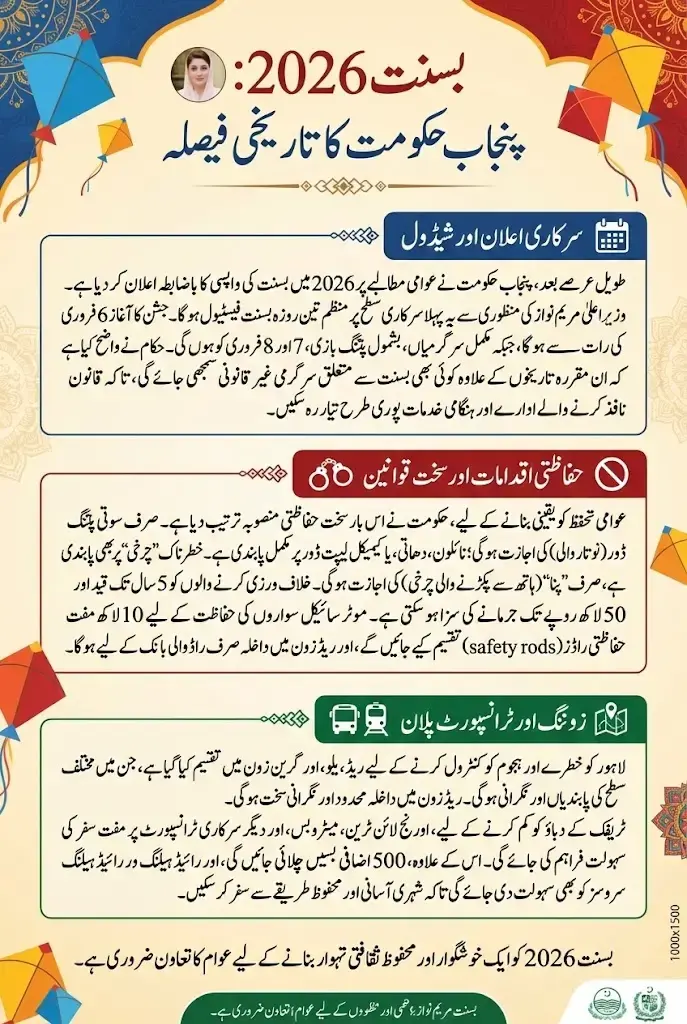
After years of confusion, rumors, and half-answers, Basant is officially back on the calendar in Lahore. The Punjab Government has confirmed a three-day Basant Festival from 6th to 8th February 2026, with a tightly controlled framework built around safety, registration, and enforcement.
This is not a return to the free-for-all Basant of the past. It is a regulated event, shaped by past mistakes and political accountability.
Official Announcement & Government Authority
Chief Minister of Punjab: Maryam Nawaz Sharif
The revival of Basant in 2026 comes directly under the authority of Chief Minister Maryam Nawaz Sharif, marking the first time in years that the Punjab government has publicly taken ownership of the festival rather than distancing itself from it.
This matters. Basant has historically collapsed whenever responsibility became unclear.
Punjab Government’s Official Position on Basant 2026
The government’s stance is simple: culture can return, chaos cannot. Basant is being treated as a managed public event, not a private activity left to chance. Every major aspect—kite material, flying zones, registrations, markets, and enforcement—falls under formal oversight.
Why This Announcement Matters After Years of Ban
For over a decade, Basant existed in a legal grey area filled with rumors and selective enforcement. This announcement ends that ambiguity. Citizens now have a clear answer to a question that resurfaced every spring: Is Basant allowed or not?
In 2026, the answer is conditional, regulated, and enforceable.
Verified Sources & Official Channels
All updates, registrations, and notices are being routed through official Punjab government platforms. Any information not traceable to government channels should be treated as unreliable, regardless of how widely it circulates on social media.
Basant Festival 2026 Dates & Schedule
Confirmed Dates: 6th, 7th, 8th February 2026
The festival will run Thursday to Saturday, aligning with peak public participation while allowing authorities to manage crowds and enforcement over a defined period.
Daily Timing and Activity Windows
Kite flying and related activities are restricted to approved hours, based on daylight visibility and safety monitoring. These time windows are designed to reduce accidents, improve enforcement visibility, and limit uncontrolled night flying.
Day vs Night Kite Flying Policy
Night kite flying—historically one of the most dangerous aspects of Basant—is restricted and closely monitored. Any permissions granted are limited, location-specific, and subject to immediate cancellation if violations occur.
Citywide vs Designated Area Celebrations
Basant is not citywide by default. Lahore has designated areas where activities are permitted, while other zones remain restricted. Participation depends on location, not enthusiasm.
Why Basant Is Being Revived in 2026
Cultural Preservation Argument
Basant has long been tied to Lahore’s seasonal identity. The government’s position acknowledges that banning a cultural practice without offering a structured alternative only drives it underground.
Public Demand and Social Pressure
Despite the ban, Basant never truly disappeared. Public pressure—especially from families, cultural groups, and local traders—played a role in pushing authorities toward regulation instead of denial.
Policy Shift From Total Ban to Regulation
The earlier approach focused on prohibition. The 2026 framework focuses on control, traceability, and accountability. This shift reflects lessons learned, not nostalgia.
Lessons Learned From Past Incidents
Previous tragedies were not random. They resulted from unchecked kite materials, illegal manufacturing, and absent enforcement. The current policy directly targets those failure points rather than blaming the festival itself.
Balancing Culture With Public Safety
The revival is not framed as a celebration at any cost. It is framed as a test: whether Lahore can observe tradition without repeating its worst outcomes.
Cultural Significance of Basant in Lahore
Historical Roots in Lahore
Basant predates modern politics. It was once tied to seasonal change, rooftops, and neighborhood gatherings rather than commercial spectacle.
How Basant Was Traditionally Celebrated
Older Basant was quieter. Fewer kites. Simpler door. More family presence. Less competition.
What Has Changed Since the Ban
The long ban altered behavior. Many families stopped flying kites altogether, while illegal practices became more dangerous and less visible.
Modern Basant vs Old Lahori Basant
The 2026 version reflects a city that has grown denser, faster, and riskier. This Basant is more regulated because Lahore itself has changed.
Inclusivity and Equal Right to Celebrate
The government’s messaging emphasizes that Basant is not limited to elite rooftops or private clubs. Public access, within rules, is part of the revival.
Safety Framework for Basant Festival 2026
Zero-Tolerance Safety Policy Explained
Certain violations—especially related to banned kite string and materials—carry no warnings and no leniency. Enforcement is immediate.
Government’s Risk Assessment Approach
Safety planning is based on past data: accident locations, injury patterns, and supply chains. Enforcement resources are deployed where risk is highest, not evenly.
Why Safety Is Central This Time
Without safety, there is no future for Basant. The government has made it clear that one uncontrolled season could end the experiment altogether.
Basant Safety Zones in Lahore
Red Zone: Areas Where Kite Flying Is Prohibited
Red Zones cover locations where kite flying poses a direct risk to life, infrastructure, or emergency movement. These typically include major roads, hospital surroundings, dense commercial areas, and sensitive government locations.
Kite flying in Red Zones is not negotiable. The presence of kites, doors, or flying equipment in these areas can trigger immediate action, even if no kite is actively being flown.
Yellow Zone: Conditional/Time-Bound Permission
Yellow Zones sit between full restriction and permission. Kite flying here depends on specific time windows, weather conditions, and local enforcement capacity.
Permissions can be withdrawn on the same day if violations spike. Past experience shows most accidents happen when temporary rules are ignored, which is why Yellow Zones are watched closely.
Green Zone: Allowed Areas With Monitoring
Green Zones are approved areas where kite flying is permitted under supervision. These are usually residential pockets with lower traffic flow and better visibility for enforcement teams.
Permission does not mean absence of rules. Monitoring remains active, and violations inside Green Zones carry the same penalties as elsewhere.
How Zones Are Enforced
Zones are enforced through:
- Physical checkpoints
- Mobile police patrols
- Rooftop inspections
- Local station reporting
Enforcement authority rests with district administrations, not private organizers.
How Citizens Can Check Their Area’s Status
Zone maps and updates are released through official Punjab government platforms and local administration notices. Social media screenshots and forwarded messages are unreliable and often outdated.
Kite Rules and Material Restrictions
Allowed Kite Sizes and Types
Only approved kite sizes are permitted. Oversized kites designed for competitive cutting are restricted due to loss of control and higher injury risk.
Decorative and lightweight recreational kites face fewer restrictions, provided materials comply.
Gudda Regulations
Gudda use is regulated to prevent aggressive cutting techniques. Weight, size, and attachment methods fall under inspection rules, especially in monitored zones.
Approved Kite Materials
Kites must be made from traditional paper and safe binding materials. Synthetic enhancements intended to increase durability or cutting strength are restricted.
There is a complete ban on glass, chemical, and metallic doors.
Glass-coated, chemically treated, and metallic doors are fully banned, without exception. Possession alone is enough to trigger legal action.
There is no concept of “light glass” or “safe chemical door” under the 2026 framework.
Penalties for Possession and Use
Penalties apply whether the dor is being used, sold, transported, or stored. Claiming ignorance does not cancel liability.
Legal Consequences & Enforcement
FIRs, Fines, and Arrest Policy
Violations can result in:
- Immediate FIR registration
- Monetary fines
- Arrest without prior warning
Severity depends on material, location, and prior record.
On-Spot Enforcement Powers
Authorized officers have the power to:
- Confiscate kites and dor
- Enter rooftops under legal authority
- Detain individuals for verification
This authority exists to prevent delays that previously allowed offenders to escape.
How Past Enforcement Failed—What’s Different Now
Earlier enforcement collapsed due to selective checks, political pressure, and lack of coordination. The 2026 model assigns clear responsibility to district administrations with direct reporting lines.
Legal Rights of Citizens During Checks
Citizens retain the right to:
- Ask for officer identification
- Receive a receipt for confiscated items
- Be informed of charges
Obstruction or confrontation, however, escalates consequences.
Motorcycle & Road Safety Measures
Mandatory Safety Measures for Riders
Motorcyclists are among the most vulnerable during Basant. Protective gear is strongly enforced, especially in high-risk corridors.
Restrictions During Peak Kite Flying Hours
Temporary restrictions may be placed on certain roads during peak hours to reduce wire-related accidents.
Helmets, Wire Guards, and Police Checks
Helmet compliance is actively checked. Wire guards are recommended in high-risk areas, and checkpoints are positioned accordingly.
Emergency Response for Road Incidents
Rescue services are placed on alert throughout the festival days, with hospitals notified in advance to handle wire-related injuries.
Public Participation & Citizen Responsibility
What Citizens Are Allowed to Do
Citizens may participate within approved zones, using permitted materials, during allowed hours.
What Citizens Must Avoid
Using banned drones, flying in restricted areas, ignoring time limits, or obstructing enforcement teams leads to drones and immediate action.
Reporting Violations (Informer Incentives)
Citizens are encouraged to report violations through official channels. Verified reports may qualify for incentives, depending on enforcement outcomes.
Community Responsibility Model
The government’s approach relies on neighborhood-level responsibility. Areas with repeated violations face stricter controls.
Registration for Basant Activities (Official Process)
Why Registration Is Mandatory
Registration allows authorities to trace supply chains, limit illegal materials, and assign accountability before problems arise.
Online vs Offline Registration
Both options exist, though online registration is preferred for record accuracy and faster verification.
Registration Requirements (General)
Identity Verification
Valid identification is required for all registrants.
Business or Association Proof
Sellers, traders, and manufacturers must provide proof of operation.
Compliance Declarations
Registrants must sign declarations confirming adherence to safety and material rules.
Seller Registration
Who Qualifies as a Seller
Retail vendors selling approved kites and accessories.
Allowed Products
Only certified materials and equipment.
Market Location Restrictions
Sales are limited to approved markets and zones.
Trader Registration
Wholesale Kite & Equipment Traders
Wholesale operations must register separately due to scale and distribution impact.
Storage and Transport Rules
Warehousing and transport routes are subject to inspection.
Manufacturer Registration
Approved Manufacturing Standards
Manufacturers must follow approved material and process standards.
Inspection and Certification Process
Facilities may be inspected before and during the festival period.
Kite Flying Association (KFA) Registration
Role of KFA in Basant 2026
KFAs act as organized intermediaries between flyers and authorities.
Responsibilities and Accountability
Associations are responsible for member conduct and compliance.
Coordination With Authorities
KFAs are expected to cooperate during inspections and enforcement actions.
Market Regulation & Supply Chain Control
Approved Kite Markets in Lahore
Only designated markets are allowed to operate during Basant.
Crackdown on Illegal Manufacturing
Illegal units face closure, seizure, and prosecution.
Supply Chain Monitoring
Movement of materials is tracked to prevent unauthorized distribution.
Pricing Control & Hoarding Prevention
Artificial price hikes and stockpiling attract penalties.
Traffic, Transport & City Operations Plan
Traffic Diversions
Temporary diversions are announced in advance to manage congestion.
Restricted Roads
Certain roads may be closed during peak activity hours.
Public Transport Availability
Public transport schedules are adjusted to reduce private vehicle use.
Free Transport Initiatives (If Any)
Any free transport announcements are communicated officially and should not be assumed.
Emergency Vehicle Corridors
Dedicated corridors remain clear for ambulances and emergency services at all times.
Security Deployment & Emergency Readiness
Police Deployment Strategy
Law enforcement is stationed strategically across all zones. High-risk areas, rooftops, and market districts receive additional personnel. Deployment is based on historical data of incidents and population density, ensuring maximum coverage without disrupting daily life.
Rescue 1122 & Hospital Preparedness
Emergency services, including Rescue 1122, are on alert 24/7. Hospitals in and around Lahore have been notified, with designated staff, equipment, and emergency beds allocated for Basant-related incidents.
Fire & Electrical Safety Measures
Given previous rooftop fires and electrical hazards, temporary inspections and monitoring of electric lines and rooftop setups are in place. Fire response teams are stationed in zones prone to electrical accidents.
Crowd Management Plan
Public gatherings, especially in green and yellow zones, will be monitored to prevent overcrowding. Temporary barriers and checkpoints ensure safe movement and access for emergency vehicles.
What Tourists and Overseas Pakistanis Should Know
Is Basant Safe to Attend as a Visitor?
Yes, but only if visitors follow official guidelines. Attend designated green zones, avoid restricted areas, and do not attempt to purchase or use banned materials.
Where Visitors Are Allowed
Tourists should stick to approved celebration zones and public rooftops that have been cleared for safety. Maps and official notices are the only reliable sources for these locations.
Cultural Etiquette
Respect local customs:
- Do not interfere with neighbors’ rooftops
- Follow local timings for kite flying
- Avoid aggressive kite cutting in residential areas
Legal Warnings for Non-Residents
Ignorance of laws is not an excuse. Visitors can face fines or arrest if caught with banned materials or flying kites in restricted zones.
Common Myths vs Reality About Basant 2026
“Basant Is Fully Legal Everywhere” — Reality
Only designated zones and approved hours are legal. Kite flying outside these areas is considered illegal.
“Dor Is Allowed Again” — Reality
Glass, metallic, or chemically treated doors remain banned. Only certified kite strings are permitted.
“No Enforcement This Time” — Reality
Enforcement is stricter than ever, with clear legal authority and monitoring. Past enforcement failures have been addressed in the 2026 plan.
How Basant 2026 Will Be Monitored in Real Time
Surveillance Measures
CCTV cameras and rooftop monitoring teams track activity in high-density zones to ensure compliance.
Community Reporting
Residents can report violations through official apps and government hotlines. Verified reports are prioritized for enforcement.
Media Monitoring
Local media outlets are coordinated with authorities to report updates and incidents accurately.
Rapid Response Teams
Specialized teams are stationed in each zone to respond immediately to accidents or violations, reducing response time and risk.
Official Websites & Government Resources
- basant.punjab.gov.pk — Primary official portal
- Punjab Government Portals — Updates and notifications
- Citizen Corner—Query resolution and reporting
- Transparency & Public Notices — Regular updates and legal notices
These resources are the only reliable channels for information, registration, and alerts.
Final Advisory From Punjab Government
Message to Families
Celebrate responsibly. Stick to approved zones and use safe materials. Ensure children are supervised at all times.
Message to Youth
Follow the rules. Avoid banned dor and overcrowded rooftops. Enjoy the festival without taking unnecessary risks.
Message to Traders & Organizers
Register all activities officially. Follow safety regulations strictly. Enforcement will be non-negotiable.
Long-Term Vision for Basant in Punjab
The 2026 festival is a pilot for future sustainable celebrations. Authorities aim to restore Lahore’s cultural heritage without compromising safety.
FAQs People Are Actually Asking (High-Intent)
- Is Basant officially allowed in Lahore in 2026?
Yes, only in designated zones during permitted hours, with enforcement in place. - Can we fly kites on rooftops?
Yes, but only in approved zones and with safe kite materials. - What happens if someone uses an illegal door?
Enforcement is strict and can result in FIRs, fines, and possible arrests. - Are private Basant parties allowed?
Private gatherings are allowed only if they comply with safety rules and do not use banned materials. - Will Basant continue in future years?
Continuation depends on compliance and safety outcomes from 2026. Authorities have emphasized this as a trial year for sustainable revival.